

K-Maker
K-Maker is KurrawongAI's Knowledge Graph creation and maintenance application - providing specialised functions to create and govern data as standards-compliant Knowledge Graphs. For reference data mangement in particular, these graphs are then readily available to other applications.

Challenges for enterprise reference data
Organisations typically manage dozens of reference datasets — product classifications, status codes, geographic hierarchies, industry standards — siloed in spreadsheets, duplicated across systems, and updated without governance or traceability. The result is significant additional work, e.g. data integration, inconsistent reporting, and an inability to share reference data confidently across business units.
- Differing source systems - fragmented resources with conflicting definitions and underlying data models
- No stable identifiers — objects without persistent identity across systems, making reliable linking impossible
- Limited version control or provenance - ad-hoc spreadsheet management with no audit trail, change history or approval process
- High barrier to enterprise solutions - catalogues or database products may be appealing but require significant effort to implement
Why Reference Data Management?
Organisations increasingly recognise that managing reference data is needed for enterprise data. Vocabulary management is the accessible, high-value entry point — delivering immediate governance wins while building the foundation for broader reference data maturity. From there, improving organisational data maturity capabilities is a small step.
The K-Maker solution
K-Maker delivers four core capabilities that directly address the root causes of reference data fragmentation — without requiring large, specailised, tool development.
Vocabulary model
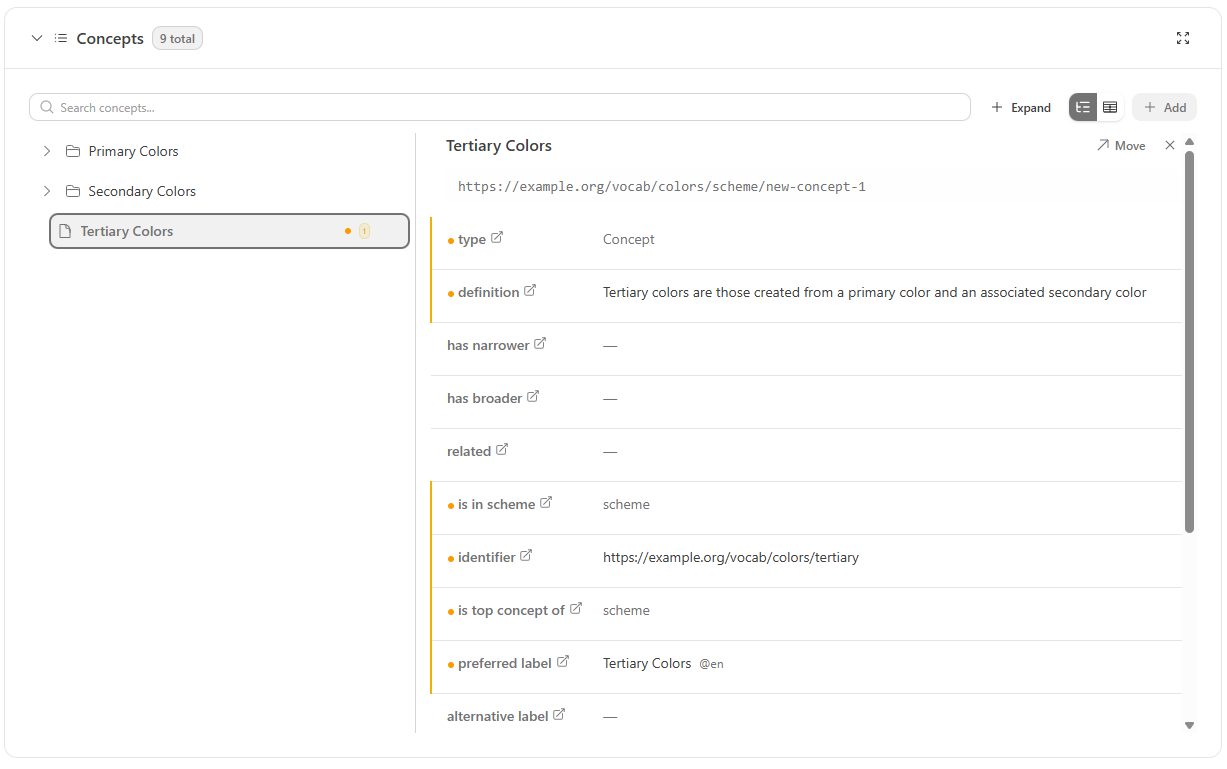
Create and curate machine-readable vocabularies to replace fragmented lists with version-controlled definitional points-of-truth. K-Maker ships with the powerful SKOS data model built-in allowing you to represent concepts in hieararcies with multiple annotations and provenance.
Data validation
K-Maker UIs are built using SHACL (Shapes Constraint Language) data definitions, ensuring every user interaction validates data against your required patterns at point of entry. Invalid data cannot enter your reference data store.
Publishing workflows
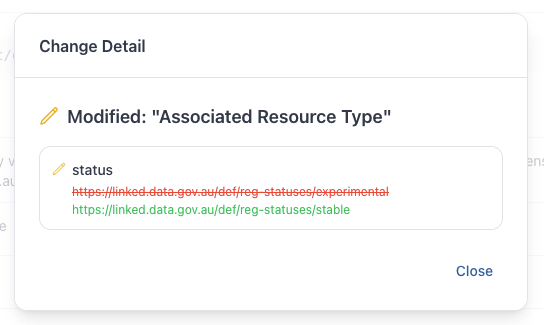
Formalised change and approval processes via a purpose-built web UI — with staging review, version control, and granular, role-based access. Every change is fully auditable from author edit through to production publication.
System integration
Any downstream system can consume governed vocabularies via REST API or embeddable web components — in multiple formats including JSON-LD, Turtle, CSV and RDF/XML. Integrate once; all consumers benefit from every future vocabulary update automatically.
How it works - from vocabulary pattern to Knowledge Graph
From SKOS vocabulary pattern to knowledge graphs, the user only has to interact with simple UI fields that are tailored to look and feel like any other organisational application.
Our approach
Data model
K-Maker has been built on standards our team both works with, and contributes to. KurrawongAI is a W3C and OGC member organisation, our staff lead working groups and edit standards within them, as well as the ISO. You can be confident that we have incorporated this expertise in development of K-Maker for Knowledge GRaph data administration.
Machine-readable & self-describing concepts
Using SKOS (Simple Knowledge Organisation System): W3C's controlled vocabularies standard
Store and manage any type of reference data
Using extensible, open standards and a graph database (handling organisational, spatial, stratographic or domain specific standards and more)
Single, persistent source of truth
Using universal data identity through Linked Data principles, regardless of how and where data is used
Provenance records at asset and sub-asset level
Using in-built version control for whole data assets and the individual elements within them
Consistent data validation
Using the SHACL for K-Maker's data schemas, validators AND UI generation, all data changes, whether manually or automatically made, are validated to the same quality




Integration & distribution
Downstream systems are able to readily consume governed vocabularies without custom per-system mappings. Integrate once; all consumers stay current with every future vocabulary update automatically.
REST API
Systems store concept URIs and resolve meaning via REST endpoints. Two patterns are supported: simple static exports for lightweight caching, and dynamic server-side APIs for complex querying and filtering.
Web components
Embed a
Export formats
Every vocabulary is available for direct download in multiple formats. From full linked data to simple flat files — whatever your downstream consumer requires, with no additional configuration.
Publishing workflows
Every change to your data passes through a staged, version control-based approval workflow that follows ISO 19135' processes. No data elements reach production without formal review and sign-off from designated approvers.
Scalability - flexibility for future complexity and volume
Vocabulary management is a common entry point, but K-Maker is a broader Knowledge Graph administration platform and is designed to grow with your organisation's data maturity.
In addition to vocabularies, it can be used to manage:
- Domain models - simple to complex ontologies, defining classes, properties and their relations. The next step up from collections of vocabularies
- Spatial data - used to locate other data. Can be spatially linked and used for map-based data selection
- Validators - it uses validators to validate all the things it edits and it can maintain the validators themselves
K-Maker also works with KurrawongAI's other tools, such as Olis for multi-graph management and Prez for Knowledge Graph display, which allows for continued growth and development of your Knowledge Graph capabilities as organisational data management matures.
Low-effort entry point
All you need to get started with K-Maker is your own data - lists of terms to be made into standardised vocabularies, data objects of relevance to your organisation, etc. If your organisation is unfamiliar with Knowledge Graph data schemas, KurrawongAI can help with that too.